


WeChat
WhatsApp


Ivory Coast Cocoa Forecast Cut to 1.5 Million Tonnes
2026-11-11 Further Africa
The Ivory Coast cocoa forecast has been cut sharply after weak October rains damaged flowering and pod development, tightening supply expectations for the world's largest producer.
Mid-crop estimate nearly halves
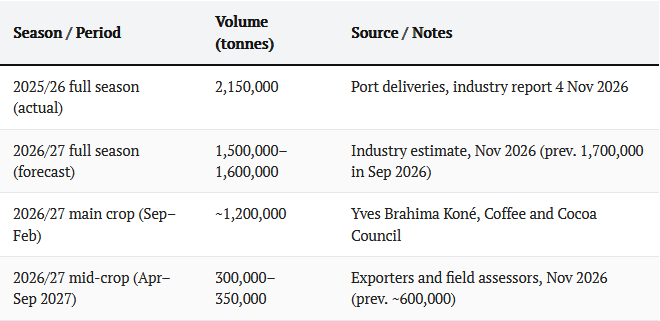
Industry participants now expect Ivory Coast's April-to-September 2027 mid-crop to reach 300,000 to 350,000 tonnes. That compares with roughly 600,000 tonnes harvested in the previous season, according to an industry report from 4 November 2026 citing exporters and field assessors.
The downgrade has also reduced the full-season outlook. Industry estimates now place 2026/27 production between 1.5 million and 1.6 million tonnes. That range sits below the 1.7 million tonnes projected in September 2026, per the same industry assessment.
The revision implies a 25% to 30% decline from the 2.15 million tonnes delivered to Ivorian ports during 2025/26. By FurtherAfrica’s reading of the numbers, that removes a substantial volume from expected West African supply.
The main crop, running September to February, is forecast at about 1.2 million tonnes. Last year it reached 1.5 million tonnes, according to figures from Yves Brahima Koné, director of Ivory Coast’s Coffee and Cocoa Council.
Rainfall remains the central risk. October showers arrived irregularly and too late to support strong flowering or pod growth, according to the November 2026 industry assessment. El Niño conditions have reduced rainfall across West Africa’s cocoa belt.
Dry Harmattan winds could add further pressure between December and March. Flowers and young pods formed after the late rains may struggle if dry conditions persist through that period.
What does the Ivory Coast cocoa forecast mean for investors?
The revised outlook shifts attention to port arrivals and near-term physical availability. Exporters expect deliveries to rise in November and December, when the main crop reaches its seasonal peak.
However, weekly arrivals may remain below last year’s levels. One European exporter expects 75,000 to 85,000 tonnes per week during those months. That compares with 100,000 to 110,000 tonnes in the equivalent period a year earlier, per the November 2026 industry report.
A separate exporter expects roughly 700,000 tonnes to arrive across November and December. Deliveries could then fall sharply, with one forecast placing January-to-February arrivals between 150,000 and 200,000 tonnes.
That pattern matters for grinders, chocolate manufacturers and commodity traders. Lower arrivals tighten physical availability. Weather uncertainty raises the prospect of price volatility in the months ahead.
Global cocoa markets have already received conflicting signals. StoneX forecast a 64,000-tonne deficit for 2026/27, reversing an earlier surplus estimate, according to its 2 November 2026 market report. Ivory Coast’s crop revision converts weather risk into a direct supply risk for global cocoa markets — the key question for traders is how far January arrivals fall short of seasonal norms.
Investors should track January and February port arrivals, Harmattan intensity, and further field surveys. Those data points will determine whether the 1.5 million-to-1.6 million-tonne production range holds through the rest of the season.
[About Afrindex]
Since 2016, Afrindex has been deeply engaged in China-Africa trade. As one of China's most authoritative B2B platforms focused exclusively on the African market, we empower Chinese enterprises to expand and thrive across Africa's diverse industries.
Service Highlights:
① Targeted Online Promotion: We deliver full-channel online exposure and intelligent buyer matching to connect you with high-precision African purchasers.
② Local On-the-Ground Support: Our resident African teams conduct face-to-face client negotiations, business visits and professional order follow-ups to accelerate deal closure.
③ Full-Cycle Trade Assistance: We provide one-stop comprehensive services covering contract confirmation, logistics arrangement, payment collection and after-sales support throughout the entire trade process.
Headquartered in Chengdu, Afrindex runs professional service centers in Shanghai and Guangzhou. With localized operational hubs established in Nigeria, Ghana, Benin, Cameroon, South Africa, Tanzania, Morocco and Algeria, we deliver fully grounded, all-round commercial services for China-Africa trade cooperatio
Follow Us:


Premium Suppliers
Top Headlines

-
 Customer Support+86-28-68731189jessica@afcan.cnFollow Us


-
Afrindex
-
Industry Clusters
-
Partner
-
Scan to ConnectWhatsAppWeChat
©Copyright 2026 Afrindex.com All Rights Reserved