
http://info.afrindex.com
China-Africa Trade Information Service
http://info.afrindex.com
China-Africa Trade Information Service
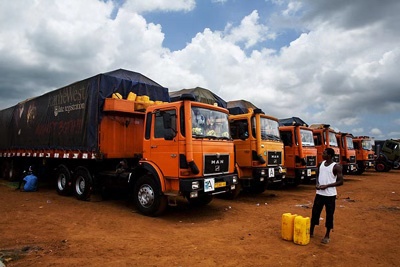
Image from achievements.africaplan.org
Road transport accounting for more than 70% of Nigeria's territory and intercity traffic due to the country's poor transportation infrastructure.
Rail projects intended to connect the country’s commercial cities are still in the works and not fully operational. Therefore, dry and wet cargo will continue to be distributed largely by commercial heavy and light duty trucks.
A significant number of the vehicles on Nigerian roads are used units imported from the United States, Germany, Netherlands and Belgium. The U.S. is responsible for nearly half of Nigeria's imports of used trucks and the Mack brand leads as the most preferred due to its perceived ruggedness and durability. Much of all imported brand-new trucks come from China. Efforts by the government to encourage local manufacture is yielding results.
Nigerian conglomerate Dangote Group in partnership with Sinotruk of China has begun an assembly factory in Lagos with the capacity to produce 10,000 trucks a year. Mitsubishi Fuso Truck and Bus Corp, in partnership with the CFAO Group, has also opened an assembly plant in Lagos with capacity to produce up to 500 Fuso Canter light duty trucks a year. The Anambra Motor Manufacturing Co (Anammco), and GM Nigeria, a joint venture between UAC of Nigeria Plc and US's General Motors Co. also assembles trucks and buses.
According to data, the total commercial vehicle sales in Nigeria to reach 6,600 units in 2021, 74% higher than 2016.
Although Nigeria has a sizeable market for buses. Before Chinese and locally made models became prominent recently, the Mercedes and Marcopolo brands were the most in demand. American buses are uncompetitive, partly, due to their high price tag compared with their Asian rivals and partly because of their low ground clearance - a major concern for bus owners given the deplorable condition of Nigerian roads.

