
http://info.afrindex.com
China-Africa Trade Information Service
http://info.afrindex.com
China-Africa Trade Information Service
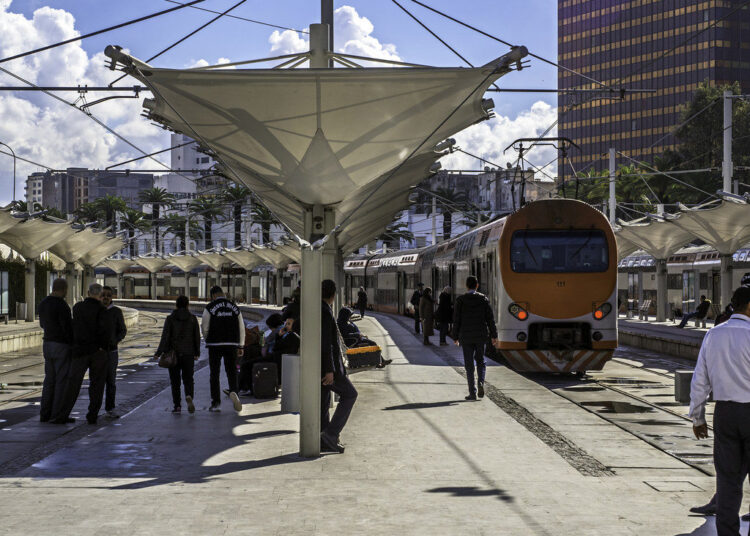
Image from Moroccoworldnews
Morocco’s National Railway Office (ONCF) is securing €202 million in funding from German development bank KfW to modernize Greater Casablanca’s railway network. This financing follows a $350 million loan approved by the World Bank in June, both supporting the “Service Intra-métropolitain Rapproché” (SIR) program.
The investments aim to improve access to employment and essential services by strengthening public transportation in Casablanca, while enhancing ONCF’s railway capacity in the region. The funding will also contribute to climate protection and improve living conditions for local populations.
Both financial packages align with Morocco’s strategy to decarbonize urban mobility systems, with rail serving as a key lever for greening transportation.
Greater Casablanca, the economic heart, has been placed at the center of the country’s green mobility transition initiatives.
According to World Bank data, Morocco is experiencing rapid urbanization, with 60% of its population currently living in urban areas, a figure expected to reach 70% by 2050. This growth is particularly pronounced in the Casablanca-Settat region, a key driver of the national economy, offering significant development opportunities.
The SIR program aims to modernize railway services by renovating and constructing stations while increasing passenger train frequency.
By June 2031, the program will improve access to sustainable transport for over 560,000 residents, increase workplace accessibility by 7%, and expand service access by 7.3%.
This initiative will ensure access to key locations within 45 minutes, expanding opportunities for residents and businesses while improving connectivity and reducing environmental impact.
The World Bank’s financial support will help implement an electrified passenger rail service connecting the urban center to suburbs such as Zenata, Mohammedia, Nouaceur, and Bouskoura.
The program will utilize a 73-kilometer railway corridor to increase track capacity and improve infrastructure, including electrical and signaling systems, with particular attention to climate resilience.
The initiative also aims to decongest current lines and strengthen freight capacity to Casablanca port. It includes investments in maintenance and modernization of infrastructure in the Casablanca-Settat region.
Fifteen multimodal railway stations will be built or redeveloped, integrating transit-oriented development principles and universal accessibility standards.
The program will also improve Greater Casablanca’s logistics facilities, focusing on rail logistics in Aïn Sebaâ and connectivity around a new logistics zone in Zenata.
Morocco’s railway revolution
This development is part of Morocco’s broader railway ambitions. The 2024-2030 period will see an investment program of MAD 96 billion ($9.6 billion), with 430 kilometers of additional high-speed lines planned, bringing the total to 630 kilometers before 2030.
ONCF expects a record-breaking 2025, with revenue projected to exceed MAD 5 billion ($500 million), a 6% increase from 2024. Last year closed with exceptional growth, carrying more than 55 million passengers, a 4% increase from the previous year.
Last April, King Mohammed VI launched construction work on the Kenitra-Marrakech High-Speed Rail Line at the Rabat-Agdal train station.
The 430-kilometer project, budgeted at MAD 53 billion ($5.3 billion), excluding rolling stock, will drastically reduce travel times across the country, with journeys between Tangier and Marrakech taking just 2 hours 40 minutes.
Looking ahead, ONCF has awarded three contracts worth MAD 29 billion ($2.9 billion) for the acquisition of 168 new-generation trains. These contracts have been distributed to international companies: Alstom for 18 high-speed trains, CAF for 40 intercity trains, and Hyundai Rotem for 110 RER (rapid transit) trains.
The Moroccan railway ecosystem is also developing industrially. Through partnerships with international manufacturers such as Alstom, CAF, and Hyundai Rotem, Morocco aims to produce train components locally and ultimately assemble complete trains.
A new factory in Benguerir will be established in partnership with Korean industrialists, with the goal of having a “Made in Morocco” train by 2030.

